

Can Sliding-Scale Pricing Make Good Food Affordable?
A tiny market in Millerton, N.Y. is testing whether it's viable to sell the same great local food at three different prices.

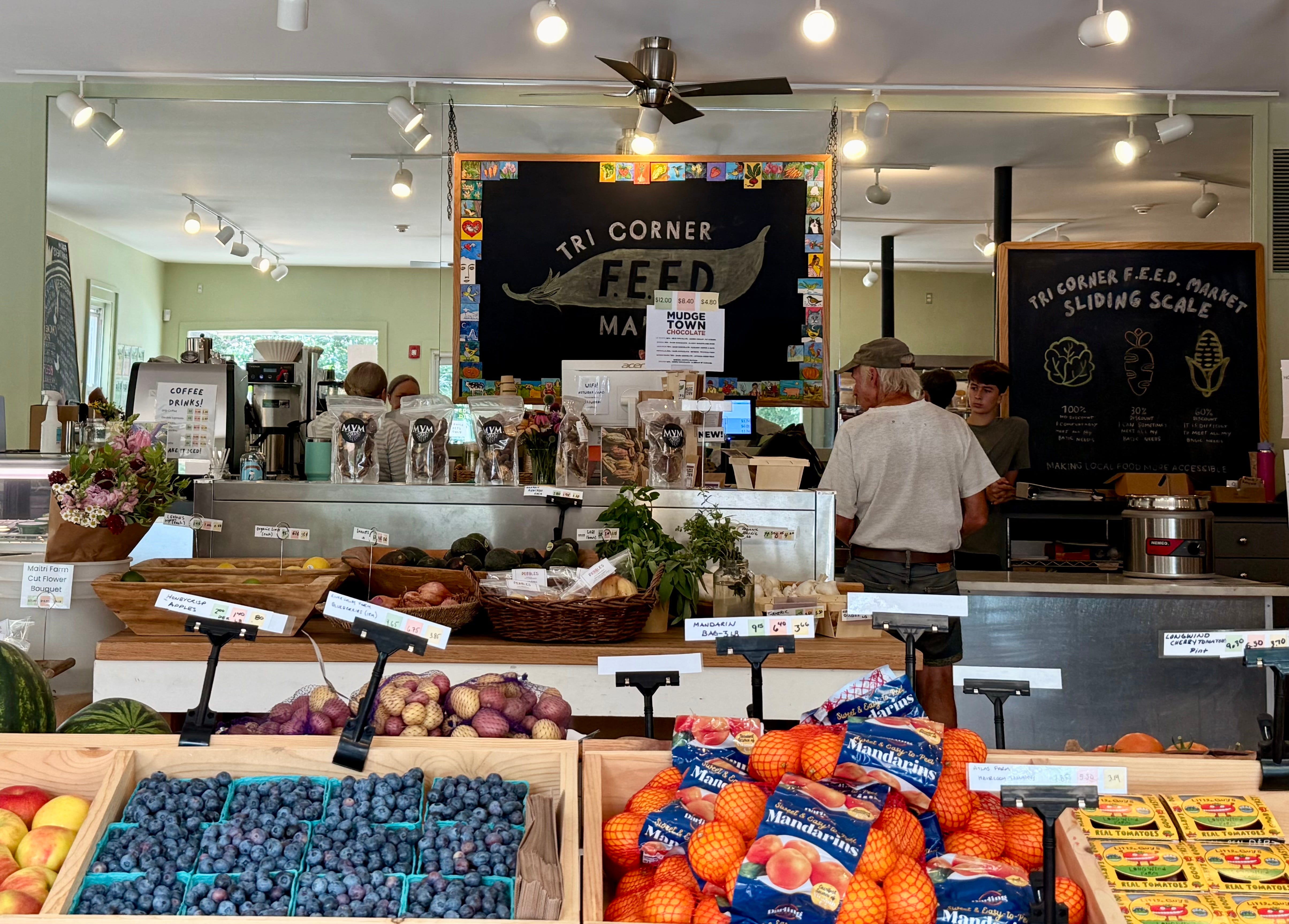
A couple of years ago, after more than two decades as full-time city people, my husband and I bought an old farmhouse in Northwest Connecticut. In the now-cliche fashion, we started renting up there to escape the city during the pandemic, and fell for the place — for the neatly painted white clapboard houses, the spectacular hiking and gravel biking, and the bobcats, foxes, and black bears that still roam the surprisingly wild Litchfield Hills. Also, for the food: family-scale livestock farms dot the region, and a good chunk of our neighbors raise something you can eat. I know how lucky we are to have all this in our lives!
Despite all the local agriculture, what the area strangely lacked for a long time was a central place to shop for what those farmers produced. I could get meat from our neighbors Dan and Marlene at Beavertides Farm, or from Whippoorwill Farm in Salisbury, but when it came to fruit, vegetables, dairy, et cetera, I was mostly buying whatever the nearest supermarket stocked. So when I heard that a market devoted to local farm products had opened just across the state line in Millerton, New York, I made a point of stopping in.
At first glance, Tri Corner F.E.E.D. looked like any of the pricey, well-provisioned country stores that you find in abundance in the Hudson Valley and throughout Vermont: local eggs, pasture-raised meat, shelves of artisanal pantry goods. But look a little closer and you notice that the shelf tag for every item lists three numbers. There’s full price — roughly what you’d pay for the same items at a farmers market. And then there are two discounted tiers, 30 percent and 60 percent off, for shoppers whose budgets won’t stretch to full freight. Opting for the discount requires no paperwork or proof of income; you decide which tier is yours when you reach the checkout counter.
I was intrigued enough by the model — and by the question of how anyone makes the math work when a locally raised, grass-fed ribeye can ring up for as little as $11.43 a pound — that I sought out the store’s founder, Linda Quella, to understand how it came to be.
Quella has taken an unexpected path to the role of grocer. She and her husband, James, spent their careers working in finance before decamping, as their kids finished college, to raise pasture-based livestock on land they bought in Sharon, Connecticut. Quella would be the first to tell you this was a privileged way to become a farmer: They bought raw acreage, built a house, and hired a farm manager. But even with that leg up, a decade of raising broiler chickens, laying hens, lamb, and cattle taught them that producing exceptional food and selling it are two very different problems. In their best sales years, they were still losing money; they couldn’t charge enough to cover their costs, even selling to a customer base that was, overwhelmingly, very affluent.
COVID crystallized Quella’s misgivings about their model. Suddenly there were lines out the farm shop door for their chicken, which struck her less as a triumph than as evidence of a broken system. “Only really wealthy people were able to access good food, because they have the means to spend a lot of money at my farm,” she said. “I thought it was insane.”
The Quellas could have simply kept selling pastured chicken to people with weekend houses. Instead, they decided to pivot to addressing the demand side of the equation. They won a federal grant, commissioned a study on how to build a market for local farmers while making the food more accessible, and landed on the sliding-scale idea now in use at Tri Corner F.E.E.D.
The market has been open for about a year. It carries a wide range of fresh, seasonal farm products, plus local meat and dairy, and pantry items sourced mostly from regional producers. On a recent visit, I picked up plump, vibrant blueberries ($9.65/$6.75/$3.85 per pint), a filet of steelhead trout ($25.71/$18.00/$10.25 per pound), sugar snap peas ($5.70/$4.00/$2.28 per pint) and Green Mountain brand creamy peanut butter ($10.82/$7.57/$4.33 per jar). Those top-tier prices are, no question, a lot; $9.65 blueberries will raise eyebrows even among Whole Foods and Sprouts shoppers. But they’re not out of line with what locally farmed food tends to cost in this corner of the world, and that’s rather the point of the other two columns on the tag: at 60 percent off, those same blueberries are $3.85, which beats the price at the nearest Stop & Shop.
The shop’s goal isn’t to shrink anyone’s grocery bill but, as Quella puts it, to let people buy more nutrient-dense food, whatever their budget. The hope is that, in aggregate, Tri Corner F.E.E.D.’s sales revenue is enough to cover the cost of supplying that food. But with the sliding-scale pricing, it won’t cover much else, including salaries, rent, and utilities; the store, which is a nonprofit, will have to fundraise to cover those costs.
Whether Quella can make the budget math work is one open question. The other is whether the honor system — trusting people to pay what they can and not take advantage — holds up. Quella says that for the most part, she thinks it does, thanks at least in part to the store’s effort to cultivate a sense of community. A store where the staff know shoppers and their families, she reasons, is one where people are likelier to pay what they can rather than game what they can. “People behave differently when they become your friend,” she said. Some of her deepest-discount shoppers will volunteer, on a good week, to pay more.
Tri Corner F.E.E.D. arrives at a moment when a handful of people are trying, in different ways, to answer the same question: How can you make high-quality food more widely accessible when prices only continue to climb? Last fall, Mark Bittman — who has spent years arguing that good food should be for everyone — put the theory into practice with a three-month pilot called Community Kitchen on Manhattan’s Lower East Side: a nonprofit restaurant serving a nine-course tasting menu on a sliding scale of $15, $45, or $125, the diner’s choice. (It closed in December, having drawn some of the hardest-to-get reservations in the city, and Bittman has said he wants to reopen it permanently and help others copy the model.) Attacking affordability from a different angle, Mayor Zohran Mamdani campaigned on a network of city-owned grocery stores meant to keep prices low by stripping out rent and profit; his administration has identified its first sites, though the earliest isn’t expected to open until late 2027, and the model is flat low pricing rather than a tiered scale. Closest of all to what Quella is doing in Millerton was a store called the MARSH Grocery Cooperative in St. Louis — a nonprofit that let shoppers pay up to 20 percent above or below list price until it shuttered in 2023, unable to sustain itself financially.
It’s fair to say that none of these efforts has come close to cracking the code for making high-quality local food affordable to all. “A lot of this is a social experiment,” Quella said — a way of asking how our relationship to food and community has gotten off track, and whether it can be nudged back. It takes a certain amount of privilege to run an experiment like this one, and Quella doesn’t pretend otherwise. But she can’t fund the difference between what the groceries sell for and what the store costs to run indefinitely, and she’s candid that she doesn’t yet know whether, or how, the market can be made viable for the long haul. Still, she’d rather take a stab at testing solutions than leave the status quo unchallenged. For her, the tiers on those shelf tags are really a question posed to everyone who walks in the door. “Do people really believe that food is a basic human right and everyone should be able to afford it,” she asks, “or do you deserve lower quality food if you can’t afford it?”
It's not surprising to me that this particular store is being tested in a small, rural community. If this kind of model ever stands a chance of working, it would only be in high trust communities. Even then, all people being honest, in any given community you are going to have a small percentage of people who are very well off, with the majority being either poor or in that middle "comfortable" range. If you have a meaningful mix of the community shopping at the place, the rich shoppers won't be enough to make up for those who need the discount over the long term.
It’s not possible to make expensive things cheap. You’ll never find cheap diamonds or cheap gold bars. If you want people to be able to buy groceries that are labor intensive to grow you need to work on improving the job skills of your community members. There is no such thing as a permanently poor person, if that person gets a better paying job they can afford better food.
You need leaders to protect workers from countries flooding us with cheap products made with slave labor. Bring manufacturing back home. Stop letting so many top college slots going to foreign students.