

Flour Power
A case for cleaning out your pantry and baking with the best

I’ll never forget the sense of wonder I felt as a young food writer discovering that every food had a story—cultural, environmental, usually both. There was chocolate and coffee, of course. But also pepper! And potatoes! One of my first, and favorite, stories I wrote for The Washington Post was about the disputed history of tiramisu. I loved-me a rabbit hole.
But even I—an enthusiastic-verging-on-annoying foodie—could understand why people had their limits. Sometimes you want a cup of coffee without having to know about how the beans were grown and by whom, and how much farmers were paid.
I knew because that’s how I felt about flour.
This was not something I was proud of. I understood that rebuilding local grain economies was important for sustainable farming. I knew from writing about stellar bakeries like Tartine in San Francisco or Seylou here in Washington that bread made with fresh-milled flour tasted better. I knew that chef Dan Barber, one of the most eloquent evangelists for local food, called flour from the grocery store “dead flour.” But I still loved the accessible, cheap all-purpose flour, something I kept forever in my pantry and used for everything.
A trip to the Kneading Conference reminded me how wrong I was.

Created by the non-profit Maine Grain Alliance, the three-day gathering in Skowhegan, Maine, brings together millers, malters, brewers, and bakers—anyone trying to build supply or demand for local grains. It was a can-do crowd, which felt good in a moment when so many things feel out of control.
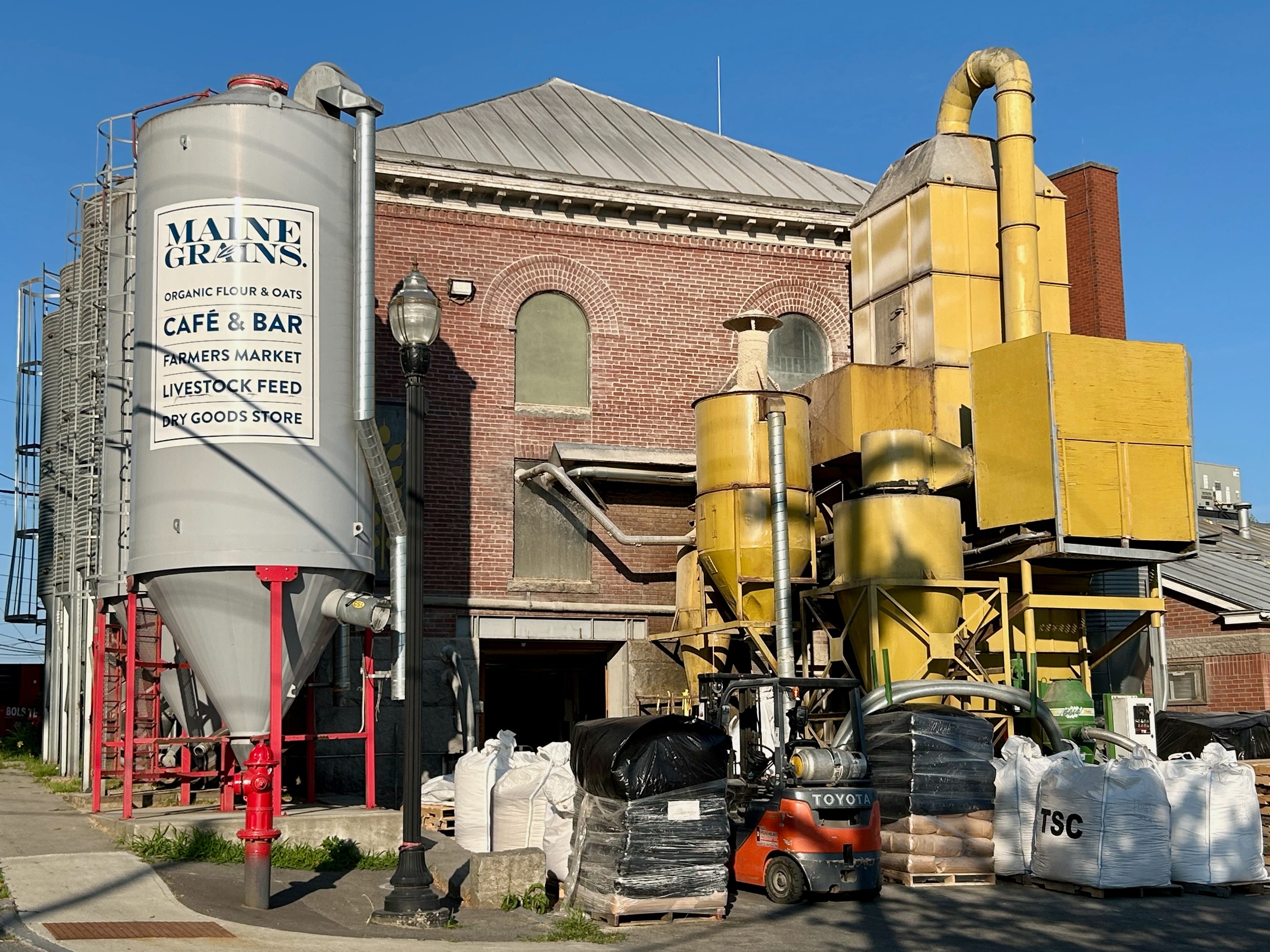
Indeed, the whole event had an early-aughts vibe—a time when I attended a lot of food conferences, all of us sharing the hope that good food could do good: for the soil, for local economies, for flavor, for health. That hope has morphed into something more complicated, less hopeful in the Trump era. Today everyone’s proteinmaxxing, slurping beef tallow, and apparently it’s peptides that are going to save us. It’s easy to feel that all of us, all those ideas, have failed. But my trip to Skowhegan proved otherwise: Even if the local food movement never changed things on a mass scale, it has succeeded in important ways, in dozens of places around the country, revitalizing communities and giving them hope—as well as great food.
For most of the 20th century, Skowhegan was a manufacturing hub, producing textiles and lumber. Though some industry remains—footwear maker New Balance and Gifford Ice Cream are still there—the town and its 8,600 residents have, like many places, struggled as the factories that had sustained them for decades disappeared.
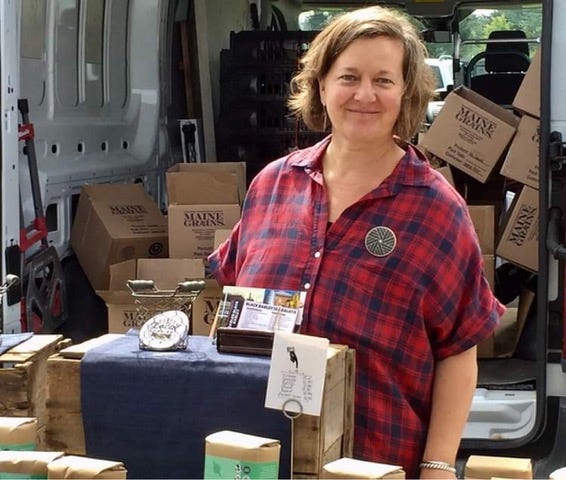
In 2007, at the height of the local-food movement, the Maine Grain Alliance saw an opportunity to use grains to bring manufacturing back to Skowhegan. Amber Lambke, a local resident, helped write a business plan, hoping that someone else would “take it and run with it.” No one did. So she ran with it herself.
Lambke purchased the old jail downtown, and transformed it into the first full-service grist mill in central Maine, and the home of her company, Maine Grains. The building, which today houses a restaurant and a tiny cheese shop, retains some of the character of the prison, and somehow this feels charming. Staff offices are in former cells; the drunk tank is a packaging center.
But the biggest challenge, Lambke says, wasn’t building out the mill. It was persuading farmers to grow grain in the first place. Maine is a potato-growing state. As recently as the 1990s, school children got three weeks off to help with the harvest. And though growing grains in rotation is good for the soil, many farmers didn’t want to risk growing something new without a guaranteed market. In 2017, five years after the mill opened, Maine Grains produced 50,000 pounds grains. Today it works with 45 farmers and produces 2.5 million pounds of whole wheat flour, oats, spelt, buckwheat—and my beloved all-purpose flour. That’s twice as much as Lambke had dared hope for in her original business plan.
The new grain economy has visibly helped rejuvenate Skowhegan. The mill created 20 jobs. Forty-five more people work at two restaurants Lambke started that use local grains in pastries and wood-fired pizzas, including one in a newly renovated spinning mill that includes a boutique hotel. Skowhegan now boasts a bakery, a fresh pasta maker, and an ice cream sandwich business, all of which use locally milled grains. “The mill has had a catalytic effect beyond my earliest visions,” Lambke said.
Perhaps the most successful new business is The Good Crust, a 100 percent whole grain pizza dough company. Launched during the pandemic, by Lambke’s twin sister Heather Kerner, The Good Crust sells to restaurants and natural food stores. But its biggest customers are Maine public schools. The state incentivizes schools to buy local products, and schools prefer a truly whole-grain crust to the ones that vendors such as Domino’s sells, which contain 51 percent whole grain, the bare minimum to meet school-food regulations.
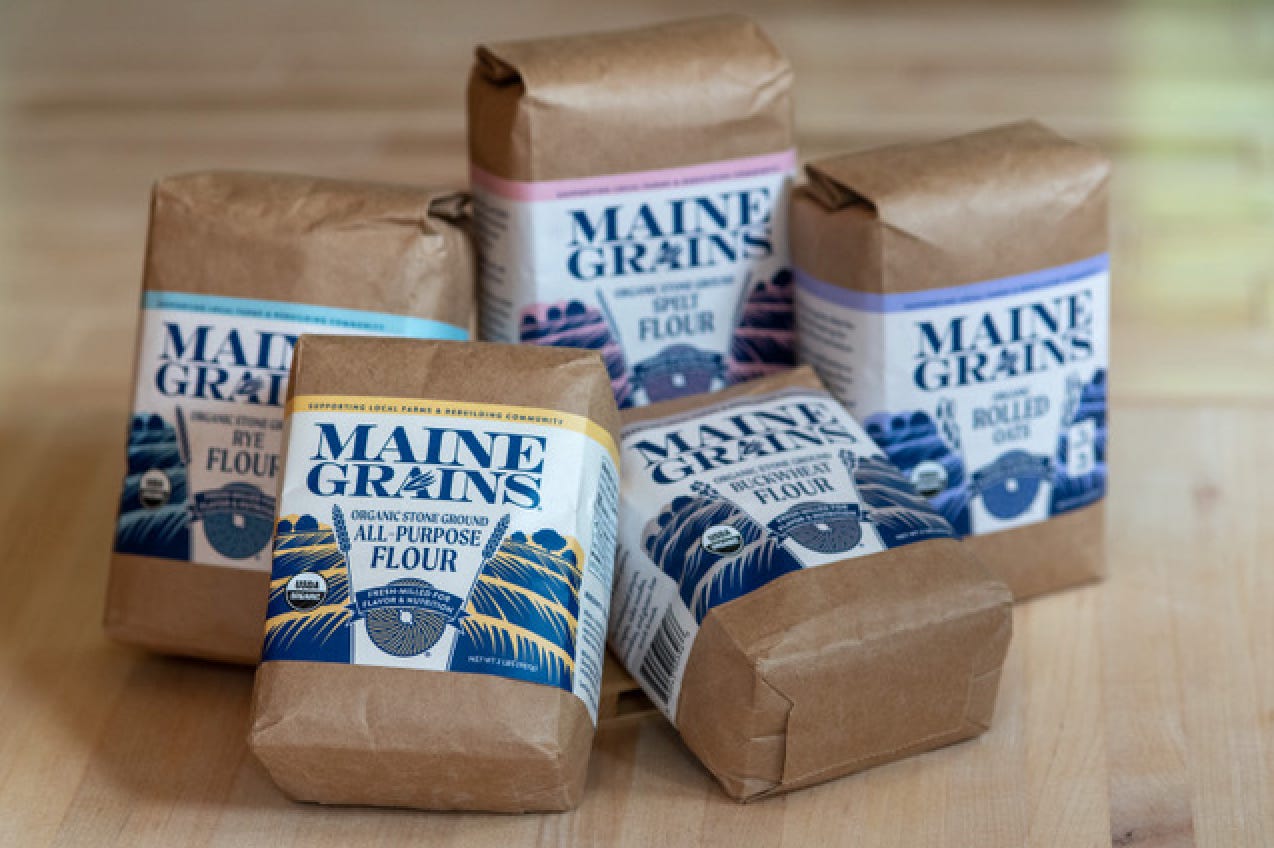
With all this economic success, it’s easy to forget the taste. And it turns out that “live” flour delivers. At the conference, I baked vanilla-rye cupcakes that had a subtle, nutty flavor—nothing that would turn off a 6-year-old at his birthday party, but that made the cake taste more interesting, more alive. At a wood-fired pizza class, the dough was a mix of white bread flour, whole-wheat flour, and Maine Grains’ spelt, which added depth and balanced out the tang and richness of the sauce and cheese. But it was the rolled oats that really blew me away. Honestly, I didn’t know oats had flavor! They were toasty and nutty baked in granola and into the crust of a blueberry tart served at the wonderful Rockport restaurant, Nina June.
Twenty years on, the local food movement hasn’t entirely figured out how to make better products cost-competitive. A 2-pound bag of Maine Grains all-purpose flour costs about $10—double what you’d pay for a good supermarket brand. But that’s mostly because the small farmers and mills don’t receive the same government subsidies as the big guys. And, it’s important to remember, fresh milled, stone-ground flour includes the healthy germ and essential oils that are stripped away in industrial flour. You get what you pay for.
I came home from Skowhegan with a suitcase full of flour. The first thing I did was rid the pantry of my old, dead grains. From now on, when possible, I’ll be using spelt in my cupcakes and my pizza crust. Not only because it’s virtuous, but because it tastes that good.
Jane you may remember I am a mutant offspring of Anson Mills Big Hominy Glenn Roberts, who insists all grains be stored in the freezer. I've been doing that so long that I forgot what pantry stored grains taste like, though my breads taste great and there are never any bugs in the pantry :)
Great reminder to support your local grain economy and, whenever possible, to explore the supply chain and meet the farmers, growers, and millers who produce our food. Thanks for the meaningful report.